
Rethinking Gradient Factors
Why deeper stops are being questioned-and what that means to your dives

If you’re a technical diver, you’re familiar with decompression theory, including gradient factors. If you’ve been a technical diver for a long time, you may used to setting your GF Lo to start your deco stops pretty deep.
But research continues, our thinking evolves, and things change. Our thinking about gradient factors isn’t quite the same as it was 10 or 15 years ago.
Especially when it comes to GF Low.
Where We Came From
For a long time, there was a strong emphasis on deep stops.
That led many divers to use lower GF Low values (often in the 20–30 range) to force earlier decompression and more time at depth.
The thinking was straightforward:
Start deco stops earlier, protect the fast tissues, and reduce bubble formation. It made sense.
But over time, that thinking has been challenged.
What Changed
Research over the last couple of decades has suggested that deep stops may not provide the benefit many divers assumed.
In some cases, they may actually be less effective than decompression strategies that emphasize time in shallower water, particularly if slower tissues are still absorbing inert gas during deep stops while the elimination of that gas is delayed by reduced time spent at shallower depths, where off-gassing is most effective.
This idea has been supported by experimental work, including studies conducted by the U.S. Navy Experimental Diving Unit (NEDU), as well as ongoing research and analysis by physiologists such as Simon J. Mitchell, David J. Doolette, and Neal Pollock. Military research, including work conducted by the Belgian Navy, has also explored these differences in decompression strategies.
What That Means for Gradient Factors
One practical result of this shift is a move toward:
Higher GF Low values
Instead of forcing deep stops with a low GF Low, some divers are choosing settings where GF Low is much closer to GF High.
In some cases, very close. Doolette has been quoted discussing the use of a GF Low that is a large percentage of GF High, resulting in decompression profiles that are less focused on deep stops and more on the shallow portion of the ascent.
That produces a different profile:
Later start to decompression stops
Less time spent deep
More emphasis on shallow stops
A Simple Example
To make this more concrete, consider a 150 ft dive for 25 minutes on air, using the same GF High but different GF Low values.
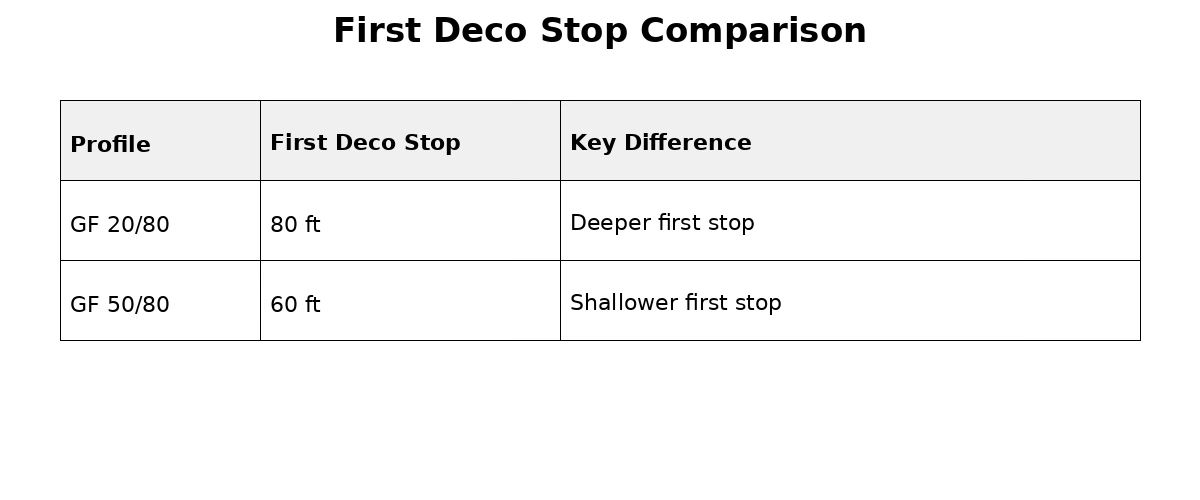
Same dive, same GF High, different GF Low. The lower GF Low creates a deeper first stop; the higher GF Low shifts more emphasis shallower.
What Hasn’t Changed
Even with this new thinking, a few things remain true:
Decompression is still not an exact science
There is no universally “correct” set of gradient factors
Different profiles, environments, and divers may justify different approaches
And importantly:
Gradient factors are still just a tool
They don’t make a dive safe.
What I Tell Students
When this topic comes up, I keep the focus on fundamentals:
Understand what your settings are doing
Be consistent
Don’t chase trends or copy numbers without context and understanding the risk
Match your planning and your execution
It’s easy to get caught up in:
“What are the best gradient factors?”
That’s usually the wrong question.
A better question is:
“Do I understand what my current settings are actually doing?”
The Takeaway
Our understanding of decompression and how we use gradient factors continues to evolve.
The move toward higher GF Low values is part of that. But it doesn’t change the fundamentals:
Good planning, consistent execution, and controlled diving matter more than any specific set of numbers.
Gradient factors shape the dive.
They don’t replace the need to understand it.
References
Doolette, D. J., & Mitchell, S. J. (2011) — U.S. Navy Experimental Diving Unit (NEDU) study comparing deep vs shallow stop decompression profiles
Mitchell, S. J., & Doolette, D. J. — Decompression and critical gas exchange
Doolette, D. — Gradient Factors in a Post–Deep Stops World, InDepth Magazine
Pollock, N. W. — Gradient Factors, Divers Alert Network (DAN)
Baker, E. C. (1998) — Clearing Up the Confusion About Deep Stops
DeRidder, Sven; Patyn, Nathalie; Neyt, Xavier; Germonpre, Peter - Selecting optimal air diving gradient factors for Belgian military divers: more conservative settings are not necessarily safer
Disclaimer:
This content is for informational purposes only and is not a substitute for formal scuba diving training. Never attempt dives beyond your certification, training, experience, or comfort level. Profiles and deco schedules presented here are for illustrative purposes only. You should never actually dive any profile or deco schedule shown here.